About
Built by a nightscape photographer,
for nightscape photographers.
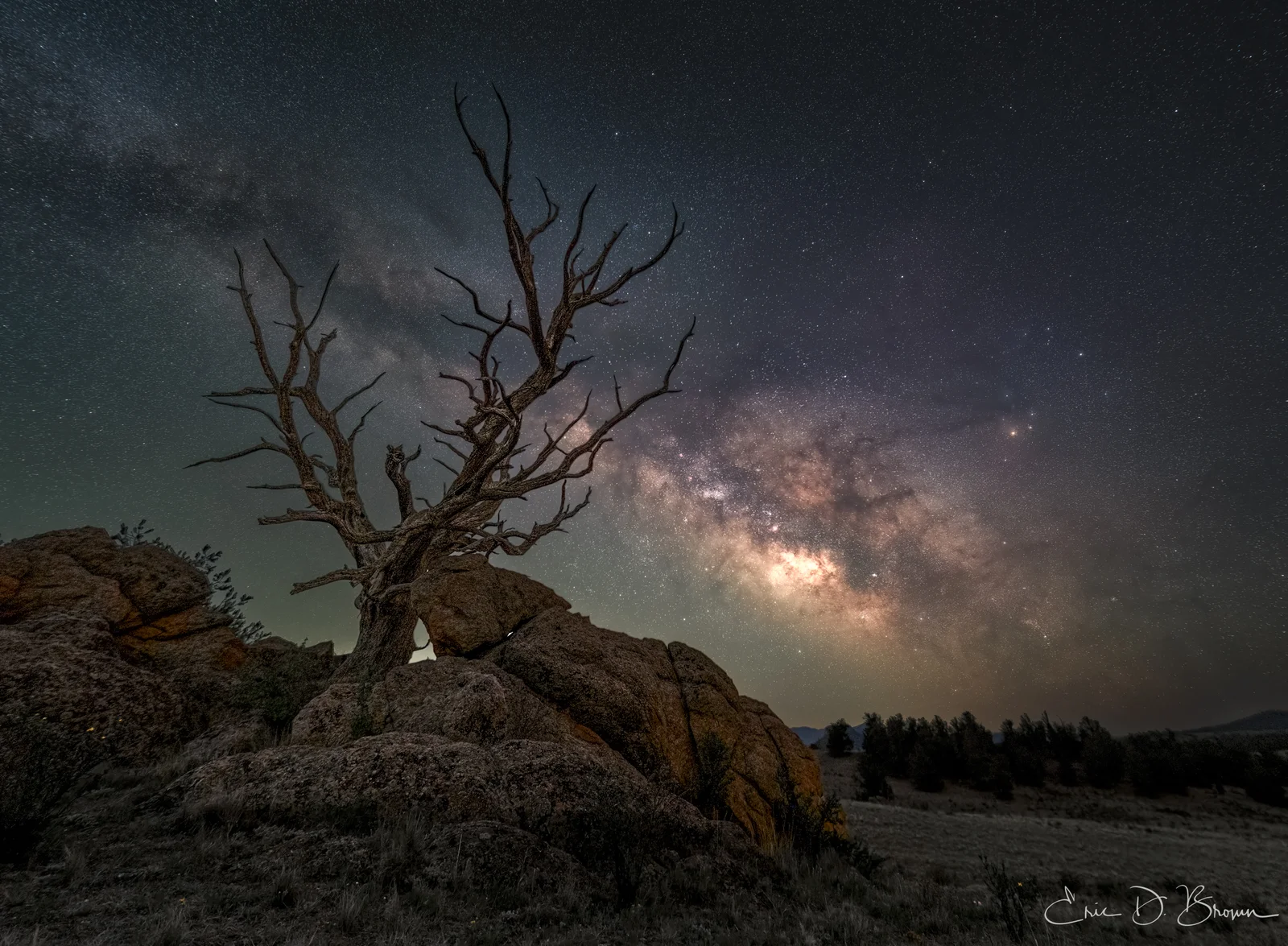
I'm Eric D. Brown, a landscape astrophotographer based in Colorado. I shoot the Milky Way. That means early alarms, late nights, and driving forest roads at 2am. I have a hard drive full of Milky Way images, a collection of wide-angle lenses, and the kind of obsessive interest in dark skies that my non-photographer friends find difficult to explain.
I also write software. NightScape Stacker is where those two things meet.
How I Got Here
When I started shooting the Milky Way, the noise problem hit me immediately. A single 25-second exposure at ISO 3200 is workable, but it is not clean. Lightroom's noise reduction helps, but it trades noise for detail, and you can see it in the stars and the galactic core. The answer everyone points you toward is stacking: shoot 15 to 20 frames, align them, average them, and you get the equivalent of a much longer exposure without the noise; and it works.
Then I went looking for software to do it.
The Software Landscape
Sequator is free and stacks landscape Milky Way shots well. It is also Windows-only. If you shoot on a Mac, it does not exist for you.
Starry Landscape Stacker was the first tool built specifically for landscape astrophotography. Mac-only, and it has not been updated in several years. It may or may not run on your current macOS version, and there is no active development to fix it if it does not.
DeepSkyStacker is free and well-regarded in the astronomy community. It is built for telescope deep-sky imaging: calibration frames, bias frames, FITS output, an interface designed for someone running a motorized mount in their backyard. If you hiked somewhere with a wide-angle lens and shot 15 frames of the Milky Way on a tripod, DeepSkyStacker is solving a different problem than the one you have.
GraXpert does gradient removal well. But it is a separate application. You stack somewhere else, export, open GraXpert, process the gradient, export again. Extra steps, extra friction. And it only handles the brightness gradient — it does not remove the color cast from sodium or LED streetlights.
PixInsight covers everything. It is also several hundred dollars and has a learning curve measured in weeks. It is built for telescope photographers doing serious deep-sky work. That is not who I am, and probably not who you are either.
What I Built
NightScape Stacker is the app I always wanted. You bring in your frames, it aligns and stacks them, removes the light pollution if you want, reduces the stars if you want, and exports a 16-bit TIFF ready for Lightroom. Four steps. Nothing you do not need.
It runs on Mac, Windows, and Linux. One purchase, one price, no subscription.
Philosophy
The creative work in landscape astrophotography happens behind the camera and in your post processing software. NightScape Stacker handles the math in between. It should do its job and get out of your way. That is the only design goal that matters.
Plan Your Shoots Too
If you are planning where and when to shoot, I also built Milky Way Planner. It helps you find the right date, time, and location for the Milky Way to align with your composition before you drive out there. The two tools are designed to work together.
Get in Touch
I read every message. If something in the app is not working, if you have a feature request, or if you just want to talk Milky Way photography, reach out. I am a photographer who built this for photographers, and that feedback is how the app gets better.